
The Dallas County Clerk's Office
John F. Warren has served as County Clerk since January 2007. The office runs many divisions, including Vital Records, Probate Courts, Criminal Courts, Civil Courts, Recording, and Commissioners Court. The clerk has pushed record technology hard, with property fraud alerts, paperless county criminal and probate systems, and digitized real estate records back to 1846.
Dallas County Clerk - Vital Records
500 Elm Street, Suite 2100
Dallas, TX 75202
(214) 653-7099
Mon-Fri 8:00 a.m.-4:30 p.m.
Before and during his time as clerk, John F. Warren worked for Dallas County for 22 years in several administrative roles, including court manager positions in the county courts at law and civil district courts. His office serves on state judicial technology and clerk association committees. That background shows in the clerk's document management system, the modern land and vital records recording system, and the digitized real estate records reaching back to 1846. The clerk's biography page covers the office history and its move toward paperless, public-access records.
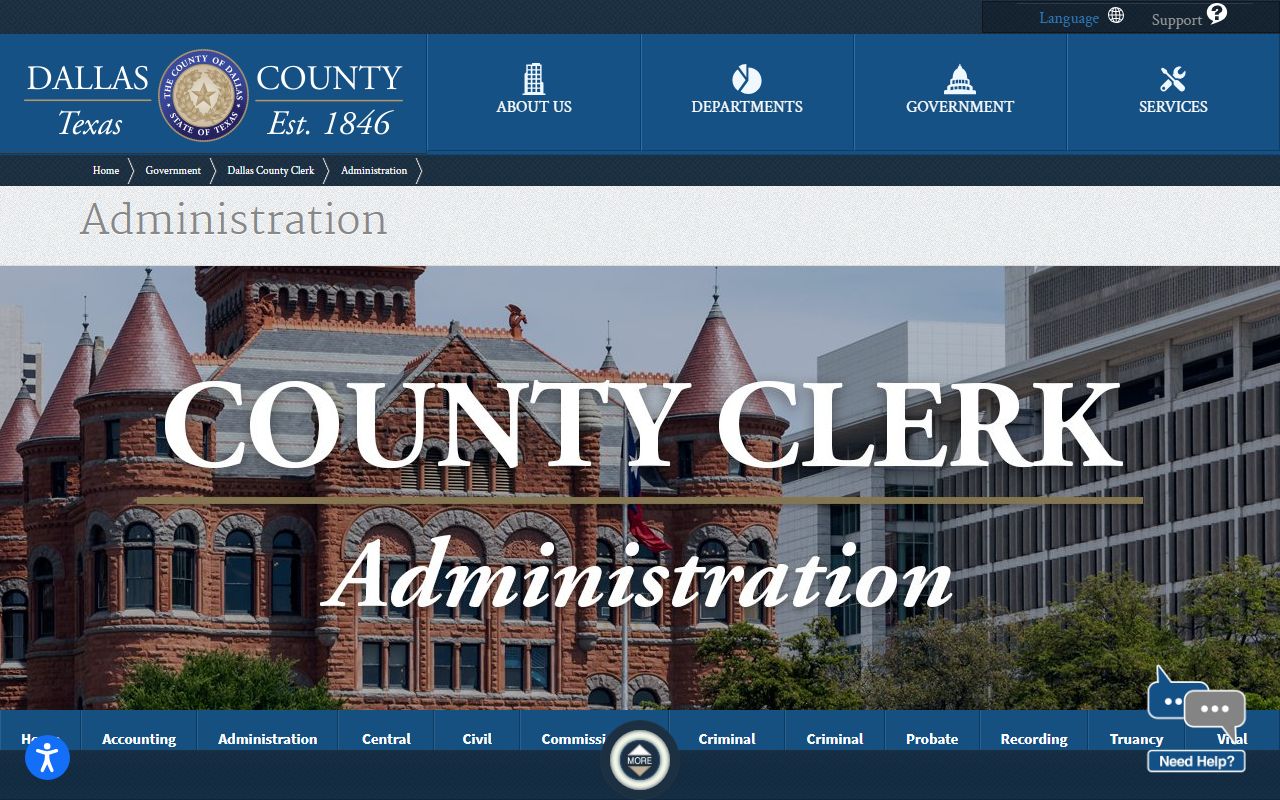
The County Clerk administration page describes the office and its records modernization.
Records the Dallas County Clerk Keeps
The County Clerk holds the records the District Clerk does not. That covers county-level courts and a wide range of official county records. District court records, like felonies and divorce, go to the District Clerk instead.
- County civil court and county criminal misdemeanor records.
- Probate court records, including estates and guardianships.
- Vital records: birth, death, and marriage.
- Official public records, recording, and assumed names.
- Commissioners court minutes and related county filings.
The Criminal Courts Division processes about 32,500 cases a year and offers a $5 misdemeanor background search. For probate detail, see the Dallas County probate records page.
County Criminal and Misdemeanor Records
The County Clerk's Criminal Courts Division handles misdemeanor cases. Dallas County has eleven county criminal courts for Class A and Class B misdemeanors, plus two county criminal courts of appeals that hear appeals from JP and municipal courts. A Class A misdemeanor carries up to a $4,000 fine, up to a year in jail, or both. A Class B carries up to $2,000, up to 180 days, or both. A Class C is fine only, up to $500.
The division performs misdemeanor background searches for $5 at the Frank Crowley building. A mail request must include the full name, date of birth, and a cashier's check or money order payable to the Dallas County Clerk. The search covers county misdemeanors only; it does not include felonies, which go through the District Clerk, or police department tickets. To file a petition for nondisclosure, the FAQ says to file with the clerk of the court where the case was filed and heard.
Vital Records: Birth, Death, and Marriage
The Vital Records Division sits in the Records Building on Elm Street. It keeps birth, death, and marriage records for many cities in Dallas County. The office reports issuing roughly 6,700 birth certificates, 7,100 death certificates, and over 18,000 marriage licenses each year.
The vital records division page lists the address, hours, and cities served. For marriage and divorce specifics, see the marriage and divorce records page.
There is one coverage detail worth noting. The County Clerk keeps birth and death records for 31 cities in Dallas County, but it does not hold City of Dallas births and deaths filed within the city limits from April 1983 to the present. Those city-limit records are handled by the city's own vital records office. So if a birth or death happened inside the City of Dallas after that date, you may need the city office instead of the county.
How to Request a Certified Copy
Certified vital records and county court copies come from the matching division. Birth and death records have eligibility rules, so be ready to prove who you are. Use these steps for a vital record copy.
- Confirm you are eligible to receive the record.
- Complete the application with the names and dates needed.
- Show an accepted government photo ID.
- Pay the fixed fee by an accepted method.
- Receive the certified copy by the chosen delivery method.
For county court or official records, you can search the portal first, then request a certified copy from the right division. Marriage records are searchable in the official records portal under the Marriage department, while a certified marriage copy is requested from Vital Records. Matching the record to the division up front keeps the request moving.
Vital Records Eligibility and ID
Recent vital records are not open to everyone. Births within 75 years and deaths within 25 years can be requested only by a qualified immediate family member, a guardian, or a legal representative. The county cannot release the record without an application, payment, and acceptable ID.
The vital records FAQ covers birth and death eligibility, marriage requirements, and ID rules. Damaged IDs that are torn, taped, or laminated are not accepted.
| Request Element | Detail |
|---|---|
| Eligibility | Qualified family, guardian, or legal representative for recent records. |
| Application | Completed form with names and dates. |
| Acceptable ID | Valid government photo ID, not damaged. |
| Payment | Fixed fee by an accepted method. |
Dallas County Clerk Fees
The County Clerk sets fixed fees for vital records and a flat misdemeanor search fee. Personal checks are not accepted, but cash, money order, cashier's check, business check, and cards are. The table below lists the main amounts.
| Item | Amount |
|---|---|
| Marriage license without certificate | $80.00 (FAQ lists $81.00; verify) |
| Marriage license with Twogether certificate | $21.00 |
| Informal marriage license | $46.00 |
| Marriage license search / certified copy | $10.00 |
| Birth certificate search / certified copy | $23.00 |
| Death certificate, first copy | $21.00 |
| Additional death certificate | $4.00 |
| Misdemeanor background search | $5.00 |
The vital records fee and payment page lists the current amounts and payment routes.
Official Public Records and Recording
The County Clerk records the county's official public records. That includes real property documents, assumed names, marks and brands, commissioners court minutes, and foreclosures. These are searched in the clerk's official records portal, which is separate from the court case portal.
The office also sells electronic certified records that are available 24 hours a day with encrypted, tamper-proof features and a digital signature. The deep digitization back to 1846, plus property fraud and identity-theft alerts, make the recording system a strong local resource. For request steps, see the Dallas County public records page.
The official records portal lets you search by department, including Property Records, Assumed Names, Marriage, Marks and Brands, Commissioners Court Minutes, and Foreclosures. You can search by party, date range, document type, and legal description. Keep in mind that an e-certified document is not the same as a non-certified image you view in a basic search. When a bank, title company, or court needs a verified copy, order the certified version rather than printing a plain screen image.
County Clerk Versus District Clerk
The two clerks split the county's court records. The County Clerk keeps county court, probate, vital, and official records. The District Clerk keeps district court records like felonies and divorce. The comparison below shows the split.
| Record | County Clerk | District Clerk |
|---|---|---|
| Misdemeanor criminal | Yes | No |
| Felony criminal | No | Yes |
| Probate and guardianship | Yes | No |
| Divorce and family | No | Yes |
| Marriage and vital records | Yes | No |
For the other side of the split, see the Dallas County District Clerk page. A simple rule helps: if the case is a felony or a divorce, it is a district court matter and the District Clerk holds it. If it is a misdemeanor, a probate matter, a marriage record, or a recorded document, the County Clerk holds it. When in doubt, the record type points to the office.