
How to Search Dallas County Probate Records
Probate cases run on the same Odyssey system as other county courts. You can find accessible probate records through the courts portal by searching the cause number or the last and first name. The County Clerk is the clerk of the probate courts, so copies and certified documents come from that office.
Have the decedent's name or the cause number ready. Then use these steps:
- Open the Dallas County Courts Portal and choose Smart Search.
- Search by cause number or by the party's last and first name.
- Filter the location to the probate courts to narrow results.
- Open the case to view the docket and filings.
- Request a certified copy, letters, or an exemplified copy from the clerk.
Estate qualifying service questions go to (214) 653-7424 or DCOpenProbateRec@dallascounty.org.
Most probate records are public, which fits the Texas open-records approach. Anyone can search the cause number or party name in the portal. Some material is limited, though, such as mental health files and any sensitive information protected by statute. So a guardianship or mental illness matter may show a docket entry while the underlying medical detail stays sealed.
The Three Dallas County Probate Courts
Dallas County has three statutory probate courts. All sit in the George L. Allen, Sr. Courts Building on the seventh floor. The probate division relocated there in 2025. The contact cards below list each court.
Probate Court
600 Commerce Street, 7th Floor Suite 400
Dallas, TX 75202
(214) 653-7236
Docket coordinator: (214) 653-7541
Probate Court No. 2
600 Commerce Street, 7th Floor Suite 400
Dallas, TX 75202
(214) 653-7138
Docket coordinator: (214) 653-7012
Probate Court No. 3
600 Commerce Street, 7th Floor Suite 400
Dallas, TX 75202
(214) 653-6166
Docket coordinator: (214) 653-6813
The County Clerk Probate Division phone is (214) 653-7099. The division processes about 5,200 cases a year and holds wills deposited for safekeeping until the testator's death.
What Dallas County Probate Records Cover
Probate is broader than wills. The Dallas County probate courts hear estates, guardianships, mental health and mental health assessment matters, and trust or special fund accounts. The County Clerk holds special fund accounts for incapacitated persons exceeding $10 million, a sign of how much the office manages.
Typical probate files include wills, letters testamentary, inventories, accountings, citations, notices, and orders. Records have permanent retention, so a decades-old estate file can still be pulled.
The County Clerk acts as clerk of the probate courts under the Texas Constitution, the Estates Code, the Family Code, and related law. Beyond estate files, the office handles wills deposited for safekeeping until a testator dies and manages trust accounts for incapacitated persons. Because the courts hear mental health matters as well, some probate records carry the confidentiality limits that apply to medical and mental health information.
Guardianship and Estate Administration
Guardianship and estate administration come with deadlines. A dependent administrator must file an annual account within 60 days of the anniversary of qualification, and a guardian faces the same 60-day annual account rule. Dallas County probate courts require an attorney ad litem in each heirship determination.
The court itself does not distribute property. An independent executor or administrator handles distribution after debts and any tax returns are settled. Statutory notice is returnable the Monday after 10 days, so if a matter is filed by noon Thursday, the earliest hearing is the Monday after the 10-day period passes. Qualifying cases may be referred to the Dallas County Dispute Resolution Center, and pro se cases are eligible without limits on discovery level or claim amount.
Common Probate Terms
Probate uses words that trip up first-time filers. The short glossary below defines the most common ones.
- Testator
- The person who made the will.
- Executor
- The person a will names to settle the estate.
- Intestate
- Dying without a valid will.
- Letters testamentary
- The court paper giving an executor authority to act.
- Guardianship
- A court arrangement to care for a person who cannot manage their own affairs.
- Conservatorship
- A court arrangement to manage another person's property or finances.
How to Probate a Will in Dallas County
A will has no legal force until it is admitted to probate. An attorney usually offers the will to the court with proper jurisdiction. In most cases, a non-lawyer cannot probate an estate on behalf of heirs or beneficiaries, since only a licensed attorney may represent another person or entity in a Texas court.
Timing matters. An application to probate a will usually must be filed within four years of the death. After a will is admitted, the court issues letters testamentary, which banks often require along with a death certificate before releasing funds. A will contest may occur up to two years after admission to probate. The probate FAQ answers many of these questions.
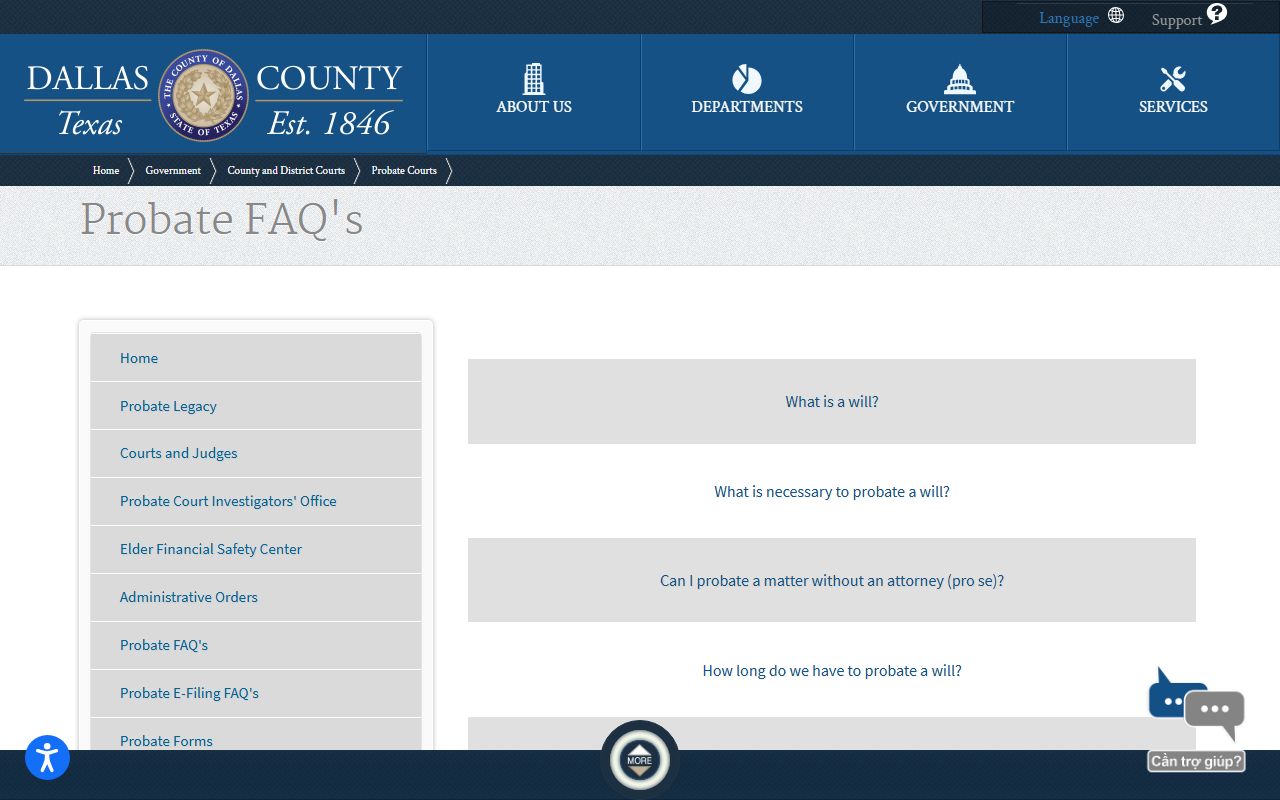
The probate court FAQ explains wills, deadlines, letters testamentary, contests, and the attorney ad litem requirement for heirship.
Probate Forms and Filings
The probate courts publish a set of forms for common filings. They include the Small Estate Affidavit, the Affidavit of Inability to Pay, a Descent and Distribution Chart, attorney fee guidelines, and virtual hearing forms. A muniment of title is a Texas option that uses a will to transfer real estate without a full administration.
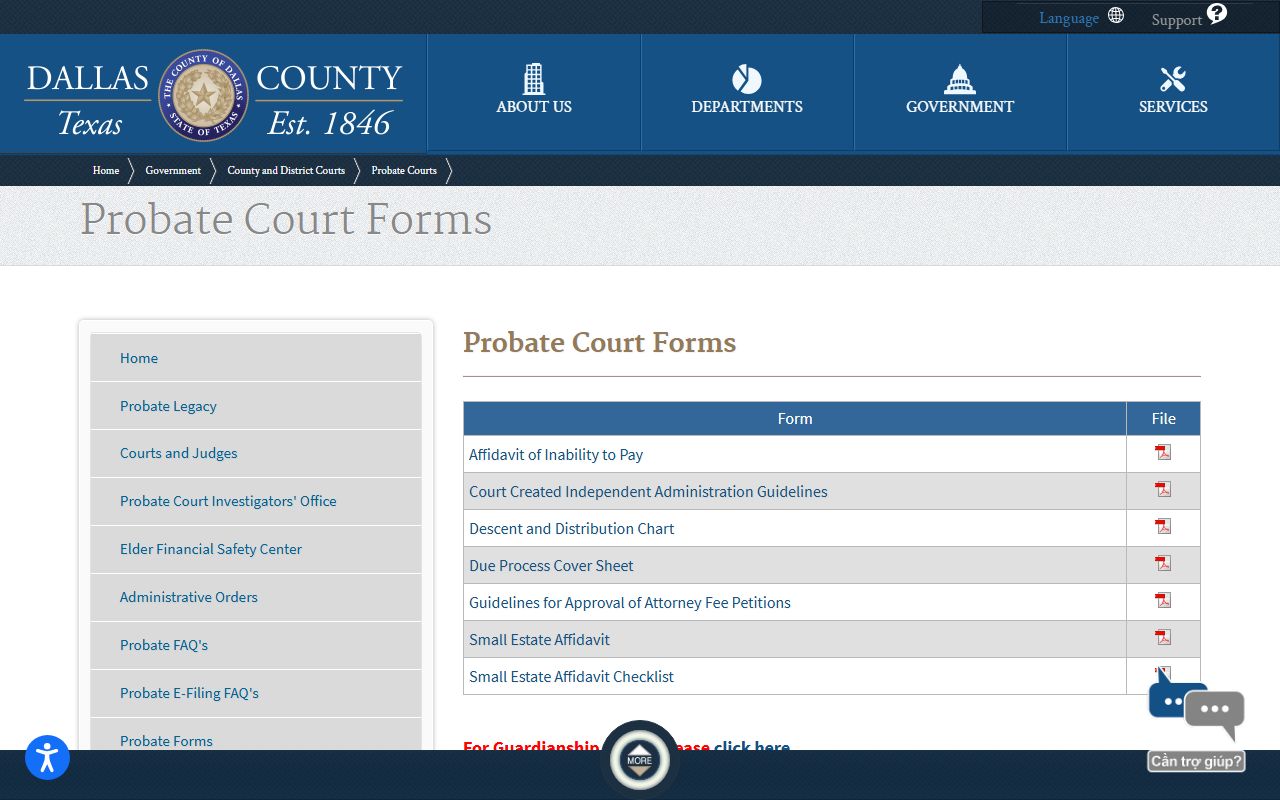
The probate forms page lists affidavits, the small estate affidavit checklist, and virtual hearing instructions. The courts may also refer qualifying cases to the county dispute resolution center. A small estate affidavit is a simpler path for modest estates that meet the statute's limits, while larger estates usually need a full administration with letters and inventories. Choosing the right form early can save weeks of delay.
Dallas County Probate Fees
Probate filing carries a base fee plus optional service charges. Certified copies, letters, and exemplified copies are priced by the clerk. The table below lists the fees noted in the county's probate materials.
| Item | Amount |
|---|---|
| Probate new application base fee | $360.00 (plus optional services) |
| Attorney ad litem deposit | $500.00 cash bond |
| Certified copies, letters, exemplified copies | Priced by the clerk |
Certified copies can be requested by e-file, mail, or in person. E-file questions go to (214) 653-7422, and service or citation questions go to (214) 653-7573 or Probate.Service@dallascounty.org.
The County Clerk also sells electronic certified official records and court documents online, available 24 hours a day with encrypted, tamper-proof features and a digital signature. These e-certified documents are not the same as the non-certified images you see in a basic online record search, so order the certified version when you need a copy for a bank or a legal filing.
Dallas County Courts and Where Probate Fits
Probate is one branch of a large county court system. The county courts landing page links the district, county, criminal, probate, and justice courts in one place. Seeing the full system helps you confirm you are in the right court.
The Dallas County courts landing page ties the court divisions together. The civil district courts handle large civil suits.
The civil district courts run from the 14th through the 298th. Felony matters sit in the criminal district courts.
The criminal district courts handle felony cases. County-level civil matters go to the county courts at law.
The county courts at law hear county-level civil cases. For the trial court roster, see the District Court page.