
How to Search Dallas County Court Records
Most Dallas County court records start at one place. The county's Online Record Search page links the court case portal, the clerk record desks, the jail lookup, and the wanted search. From there, case information for district and county courts runs through the Dallas County Courts Portal, a Tyler/Odyssey system. Public access does not require an account. You do need JavaScript and cookies turned on in your browser.
The portal you will use most is the Dallas County Courts Portal. It covers civil district courts, family district court case information, county and probate courts, and felony and misdemeanor cases. Before you start, gather what you know. A full name in Last, First Middle Suffix order works well. A case or cause number is faster if you have one.
Use these steps to run a basic search:
- Open the Courts Portal and choose Smart Search from the dashboard.
- Type a record number, or enter a party name in Last, First Middle order.
- For a wildcard name, use at least three last-name letters plus an asterisk and one first-name letter plus an asterisk.
- Open Advanced Filtering Options to narrow by court location, case type, file date, or judicial officer.
- Open a case to view the docket, then request a certified copy from the clerk if you need one for court.
Take a look at the landing page that ties these tools together before you dive in.
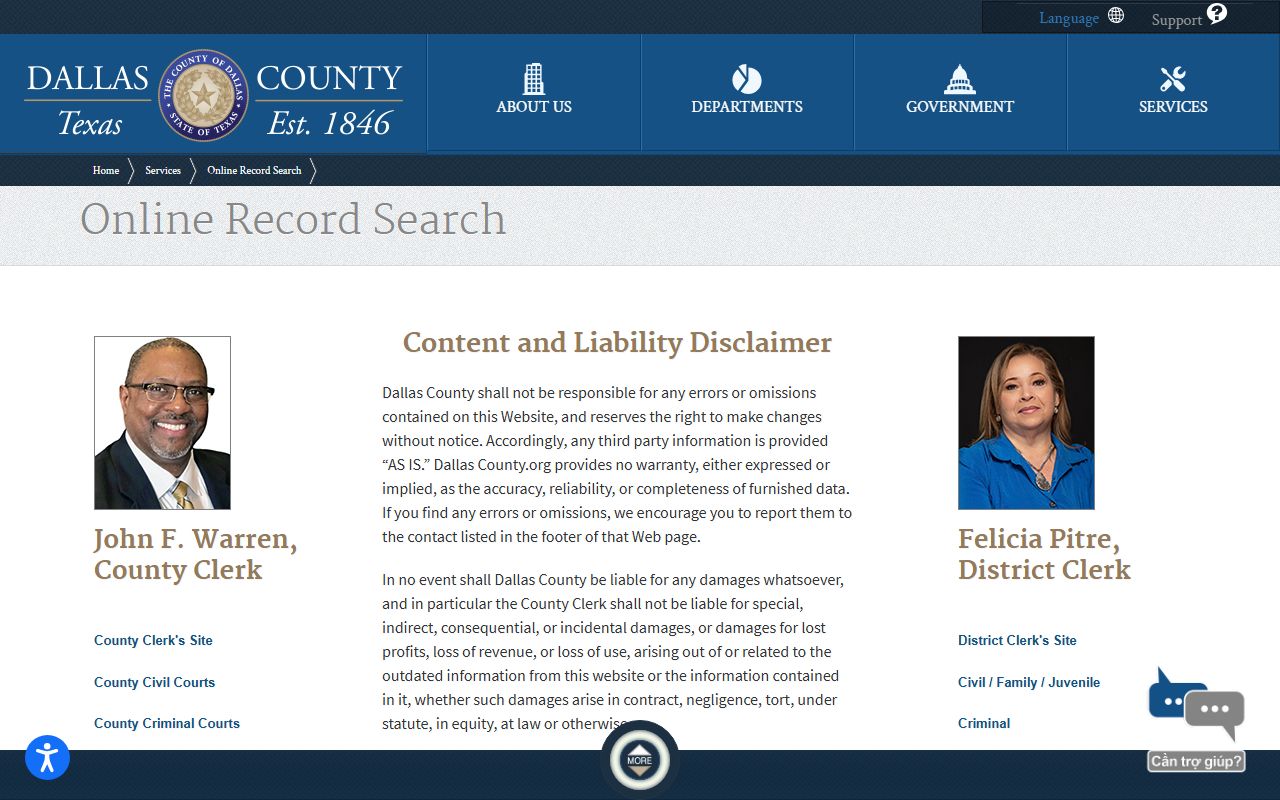
That landing page is the safest entry point because it sends each request to the correct system. The Courts Portal home below shows the Smart Search, Make Payments, and Search Hearings buttons you will use most.
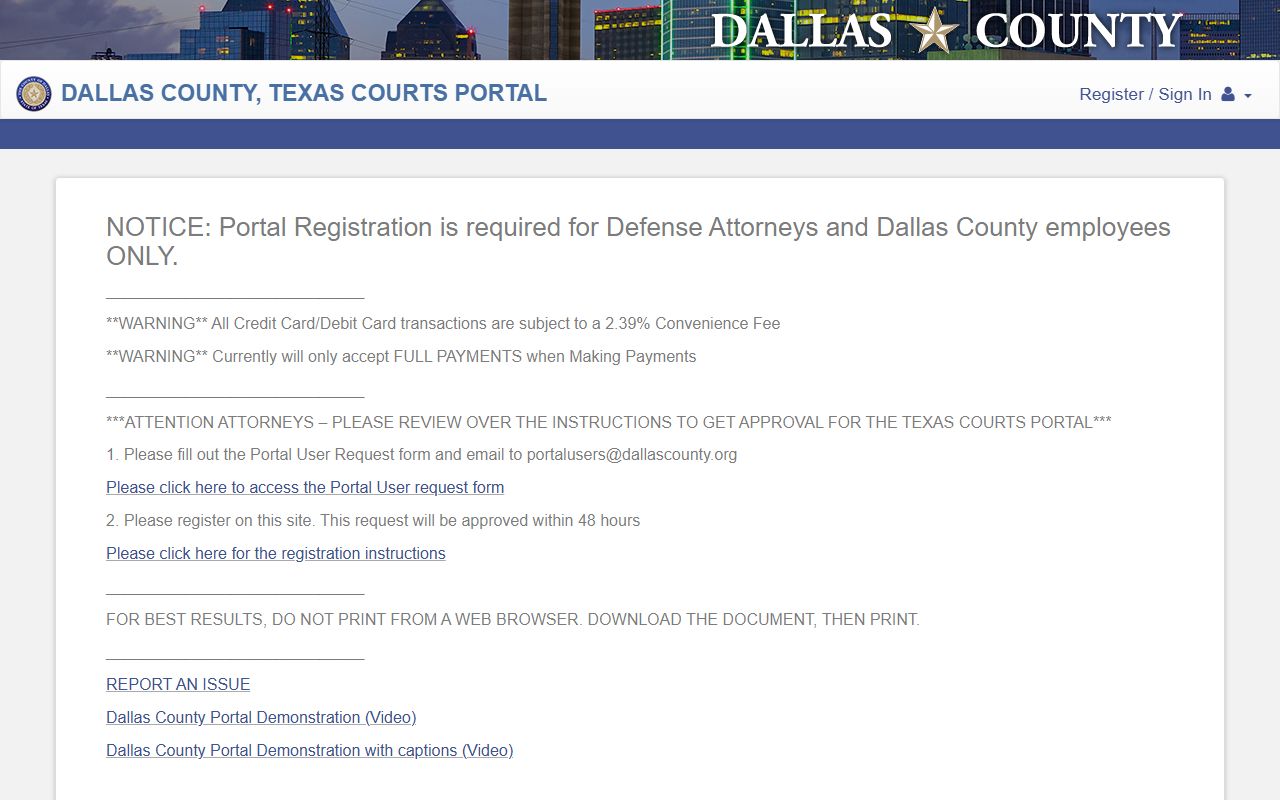
County court case questions go to CC-Inquiry@dallascounty.org. District court case questions go to DC-Inquiry@dallascounty.org.
The Dallas County Judicial System
Texas uses a layered court system, and Dallas County uses almost every layer. The Texas Judiciary lists district courts, the constitutional county court, statutory county courts at law, statutory probate courts, justice of the peace courts, and municipal courts as trial courts. Dallas County runs civil district courts, family district courts, criminal and felony district courts, county courts at law, eleven county criminal courts, three probate courts, JP courts, and city municipal courts.
Cases move up a clear ladder. A small claim or eviction may start in a justice of the peace court. Misdemeanors land in county criminal courts. Felonies and large civil suits go to district court. Appeals from district and county courts usually go to the Fifth Court of Appeals in Dallas. From there, civil and juvenile matters can reach the Supreme Court of Texas, while criminal matters can reach the Texas Court of Criminal Appeals.
Case flow: Justice Court › County Court › District Court › Court of Appeals › Court of last resort
| Court | Jurisdiction | Case Types |
|---|---|---|
| District Courts | General trial court | Felonies, civil suits, family, divorce, juvenile |
| County Criminal Courts | County-level criminal | Class A and Class B misdemeanors |
| County Courts at Law | County-level civil | Civil suits within set limits, appeals, probate-related |
| Probate Courts | Statutory probate | Wills, estates, guardianships, mental health |
| Justice of the Peace | Limited jurisdiction | Small claims, evictions, fine-only citations |
The Texas trial courts overview explains each level in more depth. For the full court roster and where each bench sits, see the Dallas County District Court page.
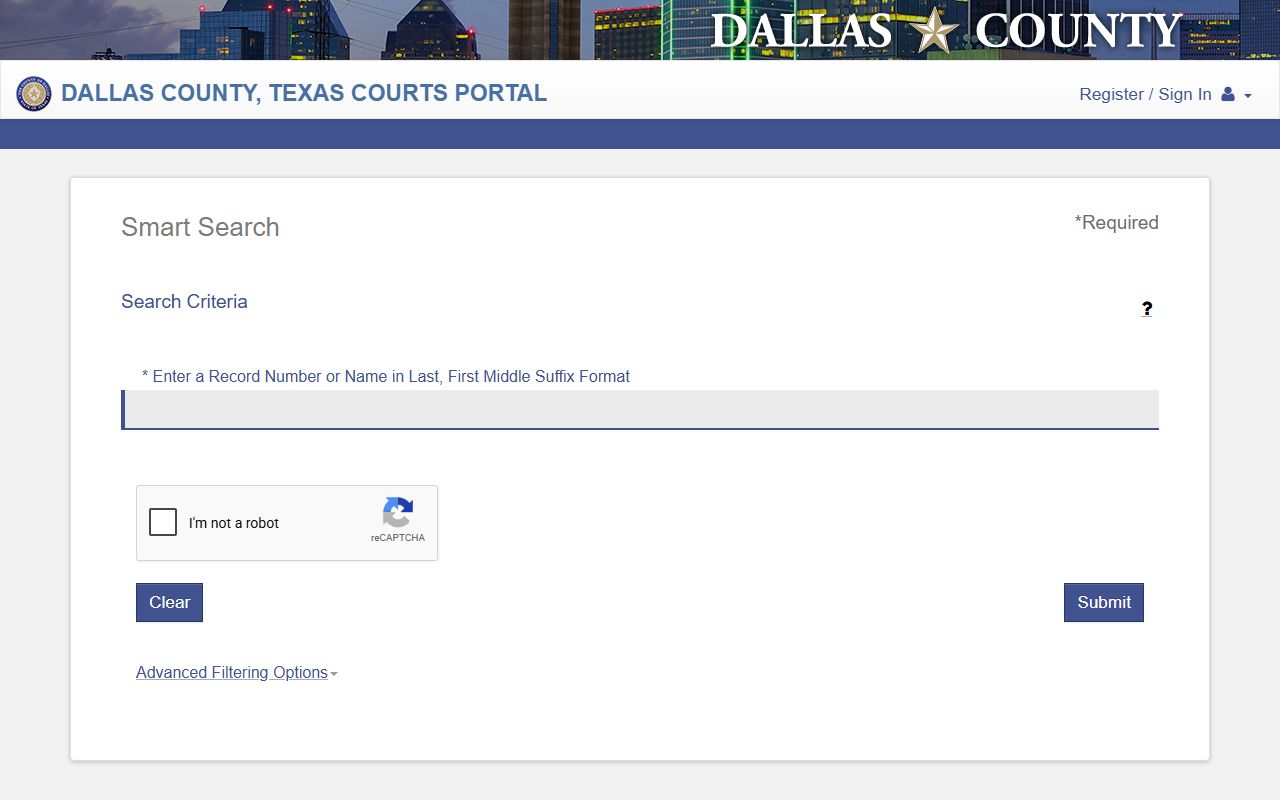
Smart Search, shown above, is the single tool that reaches across these court levels for case information.
Dallas County Courthouses
Court work is split across several downtown buildings, not one counter. Civil, family, probate, and county civil matters center on the George L. Allen, Sr. Courts Building. Criminal courts and the Sheriff sit at the Frank Crowley Courts Building. The jail bond desk is at the Lew Sterrett Justice Center, and vital records are kept at the Records Building. This split matters: a felony file, a divorce decree, a marriage license, and a jail bond can each live in a different building.
George L. Allen, Sr. Courts Building
600 Commerce Street
Dallas, TX 75202
(214) 653-7307
Frank Crowley Courts Building
133 North Riverfront Boulevard
Dallas, TX 75207
(214) 653-5950
Records Building (Vital Records)
500 Elm Street, Suite 2100
Dallas, TX 75202
(214) 653-7099
Plan for downtown one-way streets, security screening, and paid parking at all of these sites. The hearing search below lets you confirm which building and courtroom your case sits in before you go.
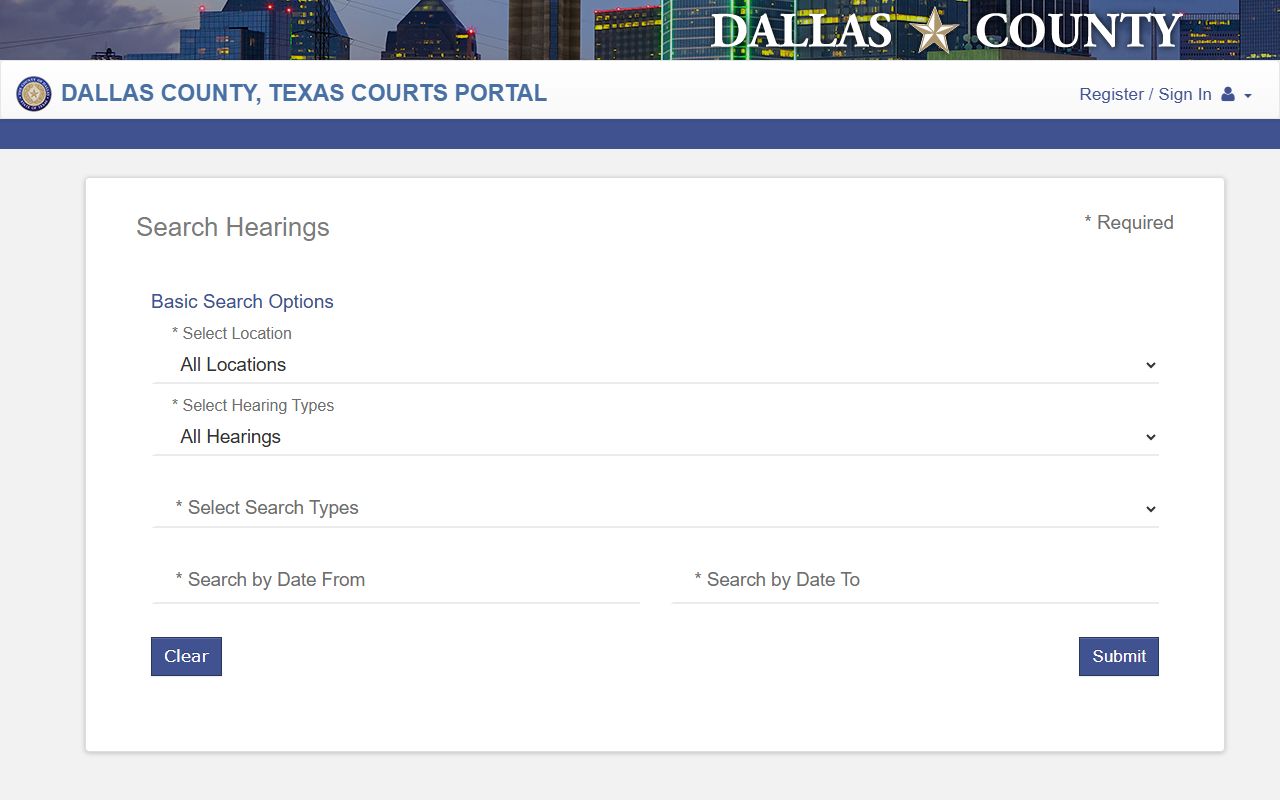
Search Hearings lets you filter by location, hearing type, party, attorney, judicial officer, and courtroom.
Types of Court Records Available in Dallas County
Dallas County court records cover a wide range of case types. The court that hears a case decides which clerk keeps the file. District courts produce felony, civil, family, and juvenile records. County courts produce misdemeanor and county civil records. Probate courts produce estate and guardianship files. Justice and municipal courts hold small claims, evictions, and most traffic citations.
Online coverage is deep but not total. Civil case information goes back to 1975, with most case files after 2008 available online. Felony case information also dates to 1975, and most felony documents after 2009 are online. Sealed files and records with children's names stay off the web.
- Criminal records - felony files in district court and Class A or B misdemeanors in county criminal courts.
- Civil records - lawsuits, contract and property disputes, injunctions, and money judgments.
- Family and divorce records - divorce, custody, support, and protective order filings, often with restricted access.
- Probate records - wills, estates, guardianships, and mental health matters.
- Traffic records - citations handled by JP courts and city municipal courts.
What Dallas County Court Records Show
A Dallas County court record is built from the fields the portal indexes. Most files show a case or cause number, the parties, the court and location, the case type, and the case status. Criminal files add booking, SO, and FBI numbers along with bond and warrant flags. Civil and family files track motions, orders, and judgments. The table below maps the common fields you will see.
| Field | What It Shows |
|---|---|
| Case Number | The unique cause or record number for the file. |
| Filing Date | The date the case was opened with the clerk. |
| Parties | Plaintiff, defendant, petitioner, or respondent names. |
| Charges / Cause | The offense charged or the civil cause of action. |
| Disposition | The outcome, such as dismissed, convicted, or judgment entered. |
| Sentence / Judgment | The punishment or final order the court signed. |
For a deeper field-by-field walkthrough, see the Dallas County court records page.
Public Access Laws for Dallas County Court Records
Texas law starts from open access. The Texas Public Information Act gives the public a right to government records without having to explain why. Court files carry that same general presumption, but several statutes carve out confidential material. Dallas County honors this balance with public portals for most records while routing sensitive files and copy requests to the right custodian.
Key Statutes:
Texas Government Code § 552.001 - sets the policy that people may access government information unless the law says otherwise.
Texas Government Code § 552.021 - the working right of access to public information held by a county.
Texas Code of Criminal Procedure Chapter 55A - governs expunction of eligible criminal records.
The Texas Legislature public information policy page explains these access rights in plain terms. For a request workflow, see the Dallas County public records page.
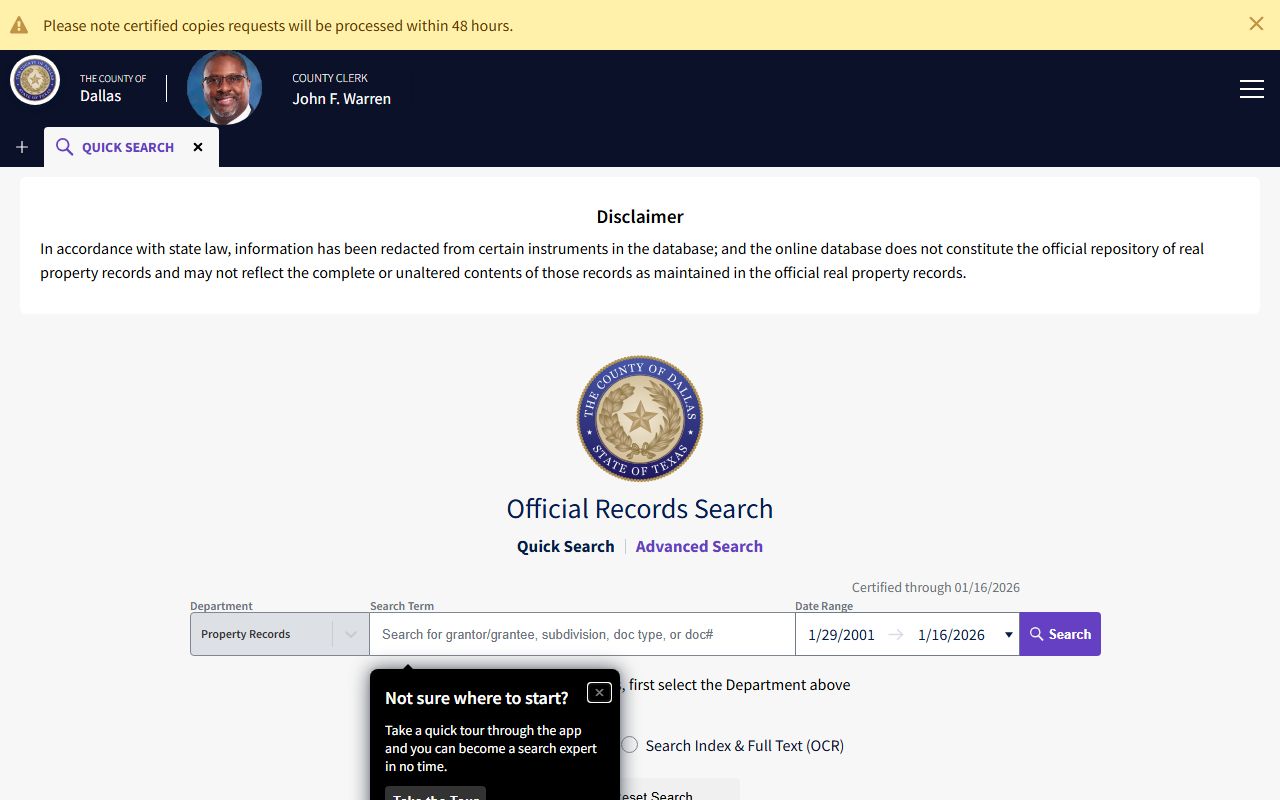
Official public records, like deeds and marriage records, use the separate County Clerk search shown above.
Records That Are Restricted or Confidential
Not every court file is open. The District Clerk says records with children's names or sexual assault victim names are not online and, if public at all, usually must be requested in person. Juvenile records are confidential under Texas Family Code Chapter 58. Mental health records are protected under Health and Safety Code Chapter 611. Adoption files are restricted under Family Code Chapter 162.
Sealed and expunged records are a separate track. A civil file can be sealed under Texas Rule of Civil Procedure 76a after a motion and findings. A criminal record can be removed by expunction or limited by an order of nondisclosure. To view a sealed record, you generally need a court order or proof that you are an authorized party. If you spot a Social Security number in a public file, the county asks you to report it through its sensitive-information form.
Specialty Courts in Dallas County
Dallas County runs many treatment-based specialty courts. The Public Defender's specialty courts page lists drug, mental health, DWI, prostitution, reentry, and veterans programs. These courts aim to treat the cause of a case instead of only punishing it.
The Dallas County Veterans Court offers an alternative to standard prosecution for eligible veterans with a mental health or substance disorder, including a medical evaluation to set the right treatment. The felony mental health ATLAS court and a misdemeanor mental health diversion court serve defendants whose cases tie back to mental illness. The county also runs felony and misdemeanor DWI courts, the STAC addiction program, a drug divert court, and a SAFPF reentry court for people returning from substance abuse felony punishment.
Dallas County Sheriff and Jail
The Dallas County Sheriff's Office is the chief law enforcement agency in the county and was established in 1846. It runs the seventh-largest jail in the United States, with an average jail population over 6,000 and more than 2,000 employees. The Sheriff lists the Frank Crowley Courts Building as headquarters, with jail and inmate information at (214) 761-9025 and warrant information at (214) 761-9026.
You can look up anyone in custody by name, book-in number, or case number. For the full roster details, mail rules, money deposits, and visitation, see the Dallas County inmate records page. To check active warrants and scofflaw blocks, use the Dallas County warrant records page. To track a release, see the released inmates page.
Marriage, Divorce, and Probate Records
Marriage licenses come from the County Clerk Vital Records Division, which also keeps birth and death records for many cities in the county. Divorce is filed in district court and handled by the District Clerk. Wills, estates, and guardianships run through three county probate courts. For more, see marriage and divorce records and probate records.
- Testator
- The person who made a will.
- Executor
- The person named in a will to settle the estate.
- Guardian
- A person the court appoints to care for someone who cannot manage their own affairs.
- Letters testamentary
- The court paper that gives an executor power to act for the estate.
Dallas County Court Records Fees
Fees depend on the office and the record. The District Clerk asks you to contact staff for an exact copy cost before you pay online, because the price turns on document length and search time. The County Clerk sets fixed fees for vital records and a flat misdemeanor search fee. Card payments in the court portal add a 2.39% convenience fee.
| Item | Amount |
|---|---|
| Misdemeanor background search (County Clerk) | $5.00 |
| Marriage license search / certified copy | $10.00 |
| Birth certificate search / certified copy | $23.00 |
| Death certificate, first copy | $21.00 |
| Civil or felony record copies (District Clerk) | Quoted by staff before payment |
The County Clerk vital records fee page lists the current vital record amounts.
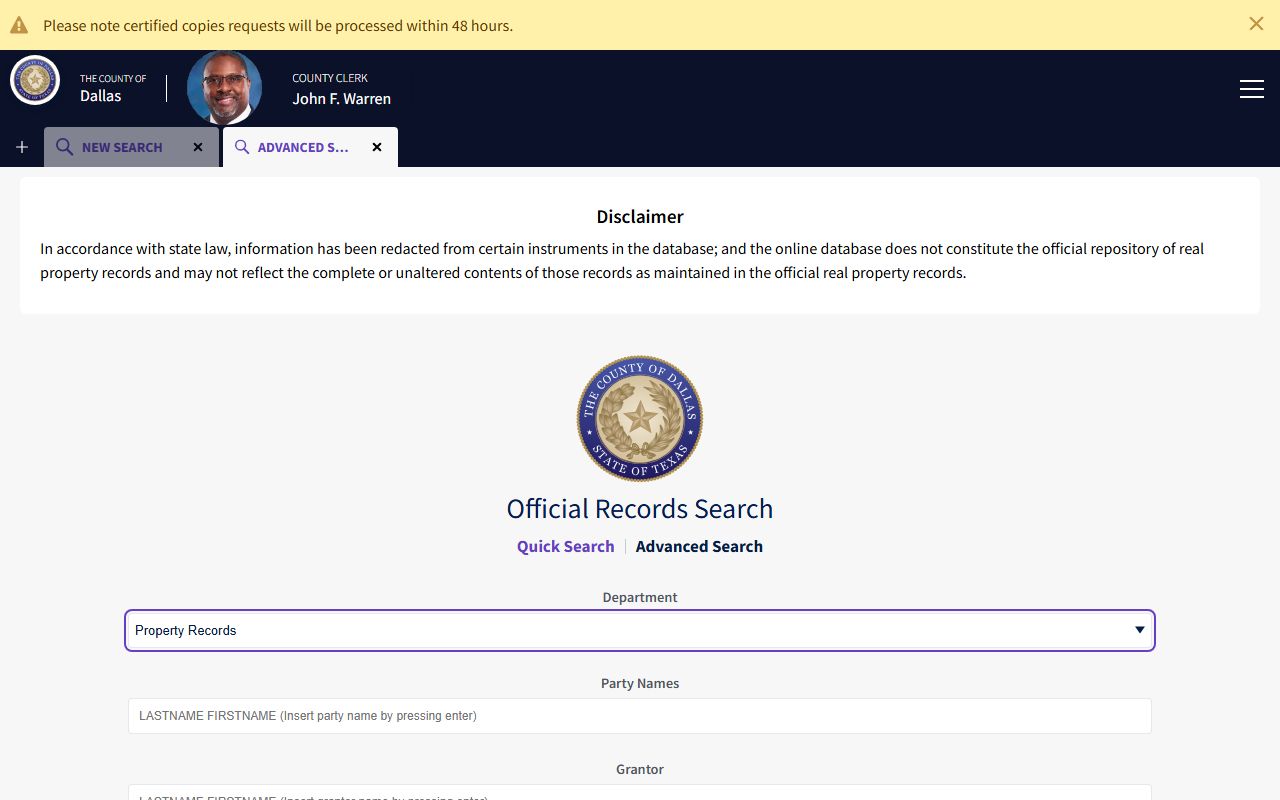
The advanced official records search above lets you look up property, marriage, and assumed name records by many fields.
How to Interpret Dallas County Court Records
Court files use shorthand that can confuse first-time readers. A charge is not the same as a conviction. A charge is only an accusation; a conviction is a finding or plea of guilt. A docket is the running list of every filing and hearing in a case. A disposition is the outcome line, such as dismissed, acquitted, or convicted.
Watch the small codes too. A capias is an order to arrest, often after a missed court date. A continuance means a hearing was put off. "Dismissed with prejudice" means the case generally cannot be refiled, while "without prejudice" leaves the door open. When a code or term is unclear, call the clerk that holds the file before you rely on it.
Accuracy and Record Limitations
Online records can lag behind the courthouse. New filings, dispositions, and corrections take time to post, and a name spelled one way in the system may differ from the spelling you expect. Placeholder data can appear in some lookups, such as unknown birth years in the wanted search.
Note: Always confirm a case detail with the clerk that holds the file before you act on it, because online data can be incomplete or out of date.
Dallas County Court Records Search Fields
Smart Search gives you one box plus a set of advanced filters. The main field takes a record number or a name in Last, First Middle Suffix order. Wildcards help when you are not sure of a spelling. The table below lists the fields that the portal exposes.
| Field Label | Type | Required | Notes / Format |
|---|---|---|---|
| Record Number or Name | Text | Yes for general search | Name format Last, First Middle Suffix; case number wildcard needs four characters. |
| Last Name | Text | Yes for party search | Wildcard: three letters plus an asterisk. |
| First Name | Text | Yes for party search | Wildcard: one letter plus an asterisk. |
| Filter by Location | Dropdown | No | Limits the search to one court group. |
| Filter by Case Type / Status | Dropdown | No | Narrows results by case category or stage. |
| File Date Start / End | Date | No | Limits results to a filing date range. |
For more on the District Clerk's civil and family files, the records page shows online coverage and request methods.
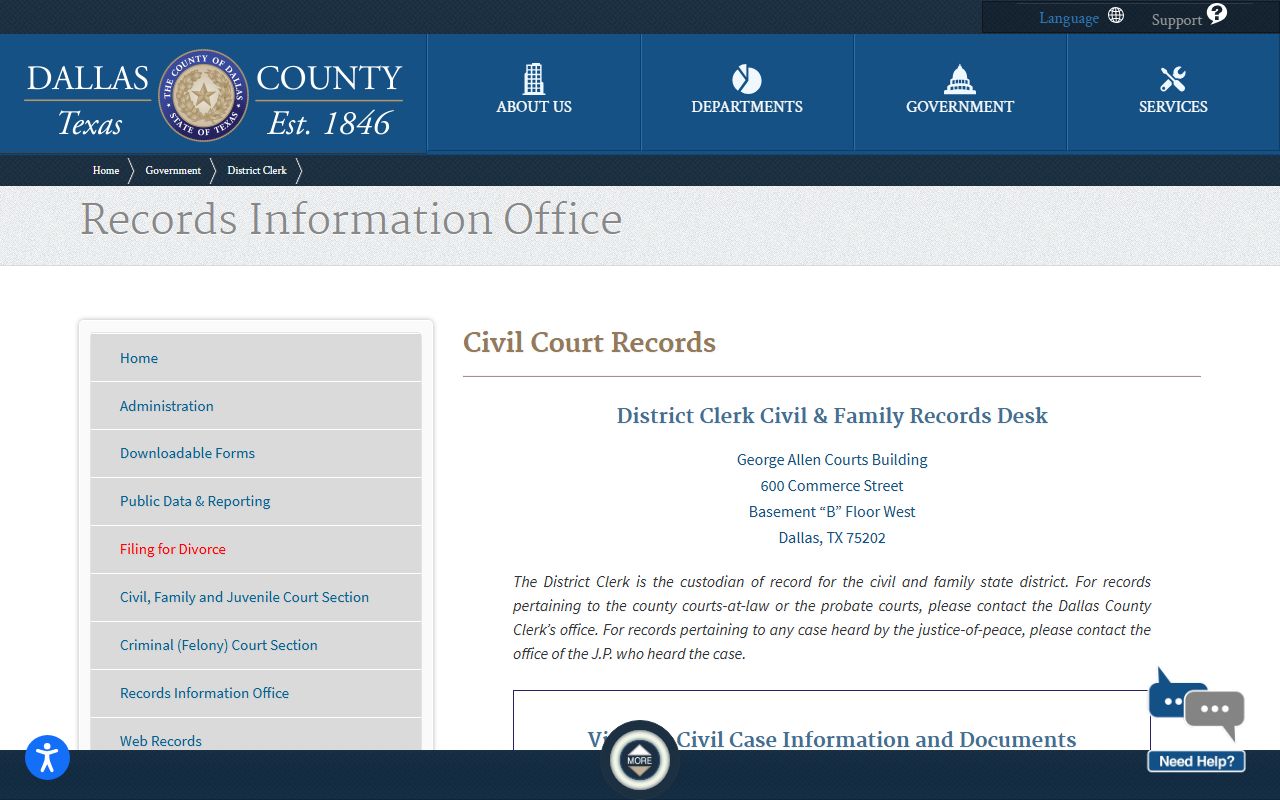
The District Clerk civil and family records page explains coverage dates, counter access, and payment. Felony coverage has its own page, shown next.
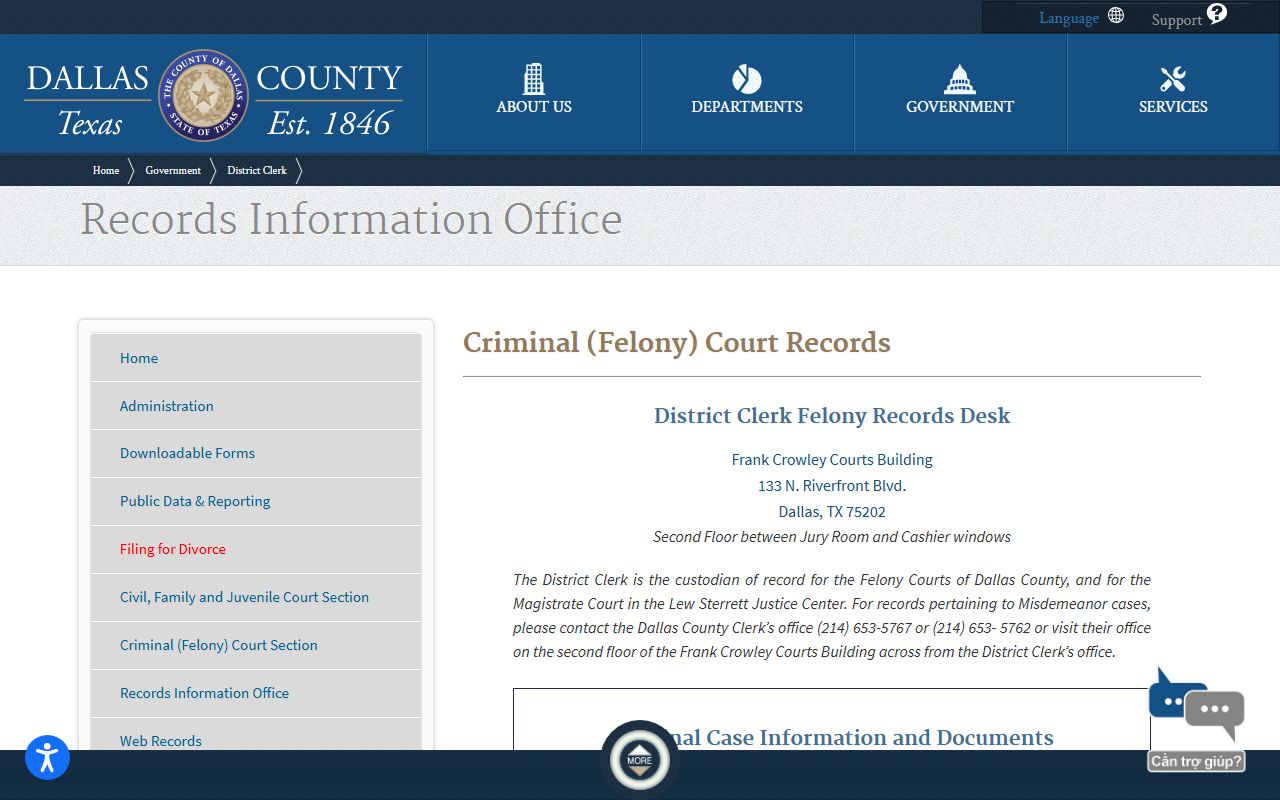
The felony records page covers online coverage from 1975, documents after 2009, and restricted-record rules.
History of Dallas County Courts
Dallas County dates to 1846, the same year the Sheriff's Office was formed. The County Clerk has digitized real estate records from 1846 to the present, which gives the county a deep, searchable record span. The Dallas County Law Library traces back to at least 1894, when it began under the staircase in the Old Red Courthouse.
Today the work has moved into modern systems. The county uses the Odyssey court management system, the GovOS official records search, electronic certified documents, and Guide & File self-help tools. In 2025 the probate courts and the County Clerk's probate division moved to the George Allen building. The records information page below is a good map of what the District Clerk holds.
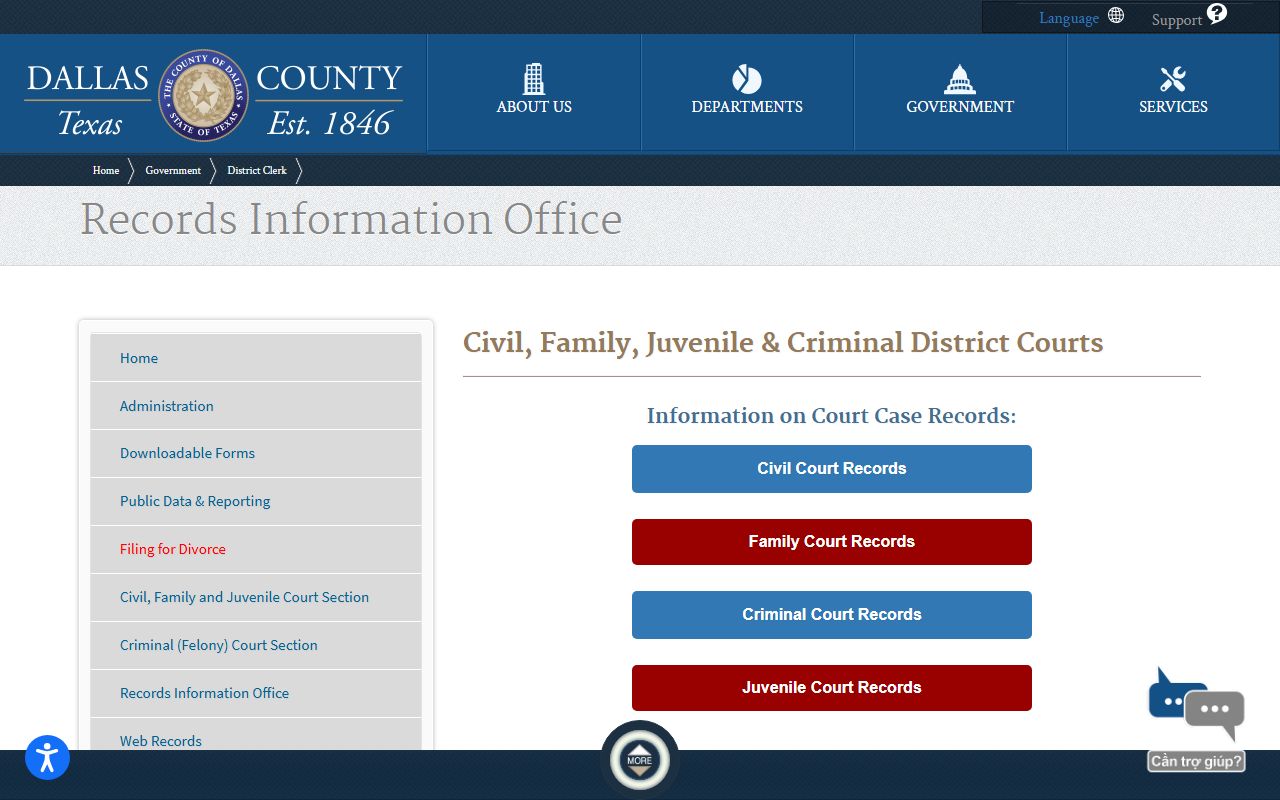
The District Clerk records information page links civil, family, juvenile, and criminal record desks, fees, and contacts.
Frequently Asked Questions
How do I search Dallas County court records online?
Open the county Online Record Search page and choose the Courts Portal. Public access is free and needs no account, but it does need JavaScript and cookies. Use Smart Search for a name or case number, and Search Hearings for hearing dates and courtrooms.
Which clerk has my record?
The District Clerk keeps civil district, family, juvenile, and felony records. The County Clerk keeps county civil, misdemeanor, probate, vital, and official public records. JP records stay with the JP court that heard the case.
Are Dallas County court records free online?
Basic search is free. Most eligible civil files after 2008 and felony documents after 2009 are online. Certified copies and some documents cost money, and card payments in the portal add a small convenience fee.
More answers are on the Dallas County court records FAQ page.